AEO tools compared
Profound vs Peec AI vs Otterly.AI (2026): Which AI Visibility Tracker Fits, and When You Need None of Them
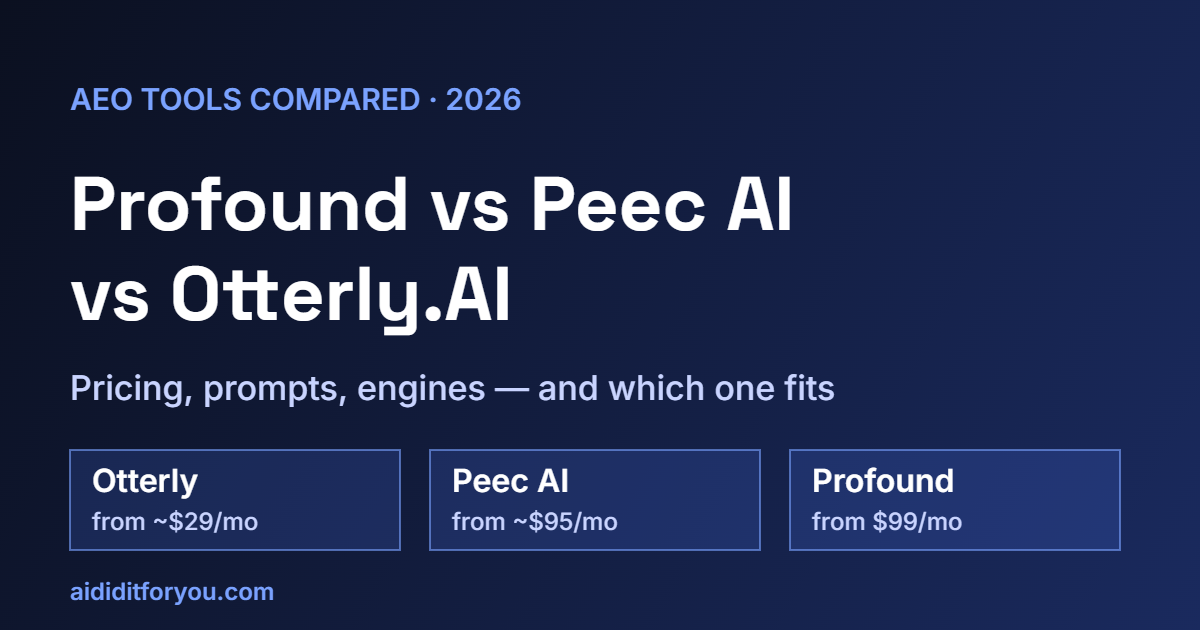
Short answer: Otterly.AI is the cheapest way to start tracking whether ChatGPT, Perplexity, Copilot and Google AI Overviews mention your brand (from about $29/month for 15 prompts). Peec AI is the best-value pick for a marketing team that wants competitor share-of-voice across three engines with unlimited seats (from roughly $95/month for 50 prompts). Profound is built for enterprises that need deep coverage and reporting; its $99 entry plan tracks ChatGPT only, so most serious buyers land on Growth ($399/month) or a custom contract. All three measure AI visibility. None of them fixes it.
What these three tools actually do
Profound, Peec AI and Otterly.AI are all AI visibility trackers. You give them a list of prompts that a buyer might type ("best payroll software for a 10-person agency", "alternatives to X"), and they run those prompts on a schedule across AI engines. Then they record whether your brand was mentioned, where in the answer it appeared, which URLs were cited as sources, how you compare to named competitors, and the sentiment of the mention.
That is genuinely useful. You cannot improve what you cannot see, and AI answers are invisible to Google Search Console and most analytics. But it is worth being clear about the category before you compare plans: these are measurement tools. They tell you that a competitor is named in 7 of 10 answers and you are named in 1. They do not rewrite your pages, add schema, or earn you the third-party mentions that usually explain the gap. (Profound has been adding content and "agent" features, which we cover below, but its core is still analytics.)
Side-by-side comparison
Pricing below is a snapshot from vendor pricing pages and recent third-party reviews as of October 2026. These vendors change plans often and some list prices in euros, so check each pricing page before you buy.
| Otterly.AI | Peec AI | Profound | |
|---|---|---|---|
| Entry plan | Lite: ~$29/mo (~$25 annual), 15 prompts | Starter: ~$95/mo (~€85–95), 50 prompts | Starter: $99/mo billed yearly, 50 prompts |
| Engines on entry plan | ChatGPT, Google AI Overviews, Perplexity, Microsoft Copilot | 3 models of your choice | ChatGPT only |
| Extra engines | Gemini, Google AI Mode, Claude as paid add-ons | Extra models as paid add-ons | Growth ($399/mo yearly) = 3 engines, 100 prompts; Enterprise = more |
| Next tiers | Standard ~$189 (100 prompts), Premium ~$489 (400 prompts) | Pro ~$245 (150 prompts), Advanced ~$495 (350 prompts) | Growth $399, Enterprise custom |
| Seats | Workspace-based; unlimited workspaces from Standard | Unlimited users on every plan | Limited seats on lower tiers |
| Best for | Solo founders, small businesses, agencies testing the water | In-house marketing teams tracking competitors | Enterprise brands, multi-market reporting |
| Main watch-out | 15 prompts is a thin sample; key engines cost extra | Add-on engines raise the real price | Entry plan is too narrow; real cost is usually a sales quote |
A fair look at each tool
Otterly.AI: the low-cost starting point
Good: the lowest published entry price in the category, a sensible default engine set (ChatGPT, AI Overviews, Perplexity and Copilot are the ones most small-business buyers actually meet), and API/MCP access from the Standard plan, which matters for agencies building their own reports.
Less good: 15 prompts on Lite is enough to watch your brand name and a handful of category questions, not enough to map a market. Gemini, Google AI Mode and Claude are add-ons, and on higher tiers those add-ons are not cheap. Per prompt, Otterly gets cheaper as you scale up, which is the reverse of Profound.
Peec AI: best value for a team
Good: 50 prompts at entry is a usable sample, you pick which three models matter for your audience, and unlimited seats means the whole marketing team (and the agency) can log in without a per-seat bill. Its competitor and source analysis is the reason most teams choose it.
Less good: pricing is set in euros, so dollar prices move with the exchange rate, and every model beyond three is an add-on. If you need ChatGPT, Perplexity, AI Overviews, Gemini and Claude, budget for the add-ons from day one.
Profound: enterprise depth
Good: the broadest engine coverage at the top end, detailed position-in-answer and citation analytics, and a growing set of content and "agent" features aimed at acting on the data rather than only reporting it. If you need a defensible board-level AI visibility number across many markets, this is the tool most often shortlisted.
Less good: the $99 Starter plan tracks ChatGPT only, which is a narrow view for a buyer journey that increasingly runs through Google's AI Overviews and Perplexity. Growth at $399/month still covers three engines, and enterprise contracts are quote-based. For a small business, that is usually more tool than the problem needs.
The math that actually decides it: prompts × engines
Ignore plan names and compare on two numbers: how many prompts you need and which engines your buyers use. A rough guide:
- Small local or niche business: 10–20 prompts (your brand, "best [service] in [city]", 3–5 "alternatives to [competitor]" questions) across ChatGPT, AI Overviews and Perplexity.
- SaaS or ecommerce brand: 40–100 prompts covering category, use case, comparison and pricing questions.
- Enterprise or multi-market: hundreds of prompts, multiple countries and languages, five or more engines.
At the entry level the cost per prompt is close across all three (roughly $1.90–$2 per prompt per month). The gap opens at scale and with add-on engines, which is where you should run your own numbers.
Which one should you pick?
- You just want to know if AI mentions you at all: don't pay yet. Run the free check below first.
- Solo founder or small business, ready to monitor: Otterly Lite, with your 15 prompts chosen carefully.
- Marketing team benchmarking against competitors: Peec AI Starter or Pro.
- Agency reporting for several clients: Otterly Standard (unlimited workspaces, API) or Peec Pro.
- Enterprise brand, many markets, board reporting: Profound Growth or Enterprise, and get a quote that names the engines included.
Before you pay for any of them: the free check
You can get a meaningful baseline in under an hour without a subscription:
- Write 10 prompts a real buyer would type, including two "alternatives to [competitor]" and two "best [category] for [audience]" questions.
- Run each in ChatGPT, Perplexity, Gemini and a Google search that triggers an AI Overview. Use a logged-out or private window.
- Log in a spreadsheet: mentioned (yes/no), position, which competitors appeared, and which URLs were cited.
- Run our free AI Visibility Audit or AI Visibility Scanner to see the on-page reasons (schema, crawler access, answer structure) behind what you found.
If the result is "AI never mentions us", a tracker will mostly confirm that every week. Your money is better spent on fixing the causes first and tracking second.
Where a done-for-you Sprint fits
To be clear about our own position: we don't sell a tracker, and we're not trying to replace these three. Trackers answer "how visible are we?" The AI Visibility Sprint answers "what do we change so we get mentioned?" It is a fixed-scope, done-for-you project: rewriting key pages with answer-first summaries, adding accurate Article, FAQPage and Organization schema, making your brand facts consistent across the web, and building the comparison and "alternatives" content that AI engines pull from for competitive questions.
Many businesses will want both: fix with a Sprint, then watch the trend with Otterly or Peec. If you'd rather do the fixes yourself, start with our free Answer Capsule generator and the guide on how to get cited by AI assistants.
Honest limits
No tool and no agency can guarantee that an AI assistant will cite you. Models change, retrieval sources change, and answers are personalised. What you can do is make your pages easy to extract and trust, make your brand easy to verify, and measure the trend honestly. Anyone promising a guaranteed "#1 in ChatGPT" is selling something they can't control.
FAQ
Is Profound better than Peec AI?
For enterprises that need broad engine coverage and deep reporting, Profound is usually the stronger fit. For most marketing teams, Peec AI offers better value: more prompts and three engines at its entry price, plus unlimited seats.
What is the cheapest AI visibility tracker?
Among these three, Otterly.AI has the lowest published entry price, about $29/month for 15 prompts covering ChatGPT, Google AI Overviews, Perplexity and Copilot. A manual spreadsheet check plus a free audit tool costs nothing.
Do I need an AI visibility tool if I already use Semrush or Ahrefs?
Traditional SEO suites now include some AI visibility features, but dedicated trackers usually go deeper on prompts, citations and competitor share of voice. Check whether your existing suite already covers the engines and prompts you care about before adding another subscription.
Will an AI visibility tracker improve my rankings in ChatGPT?
No. Trackers measure. Improvement comes from changes to your content, schema, brand consistency and third-party mentions, which you do yourself or hand to a service like the AI Visibility Sprint.
How many prompts should I track?
Small businesses can learn a lot from 10–20 well-chosen prompts. SaaS and ecommerce brands usually need 40–100. Pick prompts that a real buyer would type, not just your brand name.
See where you stand before you buy a tracker
Run the free audit in two minutes, or let us do the fixing for you.
Run the free AI Visibility Audit Get the AI Visibility Sprint
Related reading
- Best AI Visibility (AEO/GEO) Tools in 2026, Compared
- AI Visibility Audit: The Complete 2026 Guide
- AEO vs SEO in 2026
Sources: Otterly.AI help center: plans and pricing · Profound pricing · Peec AI pricing · Dupple: Profound vs Peec AI. Questions or corrections: [email protected].