Careers · Learning
How to Learn Any Skill in 90 Days (Without Wasting the First 30)
Most people don't fail to learn a new skill because they lack talent. They fail because week two has no plan in it. Here's a 90-day structure that holds up, and a free tool that builds it for you in seconds.
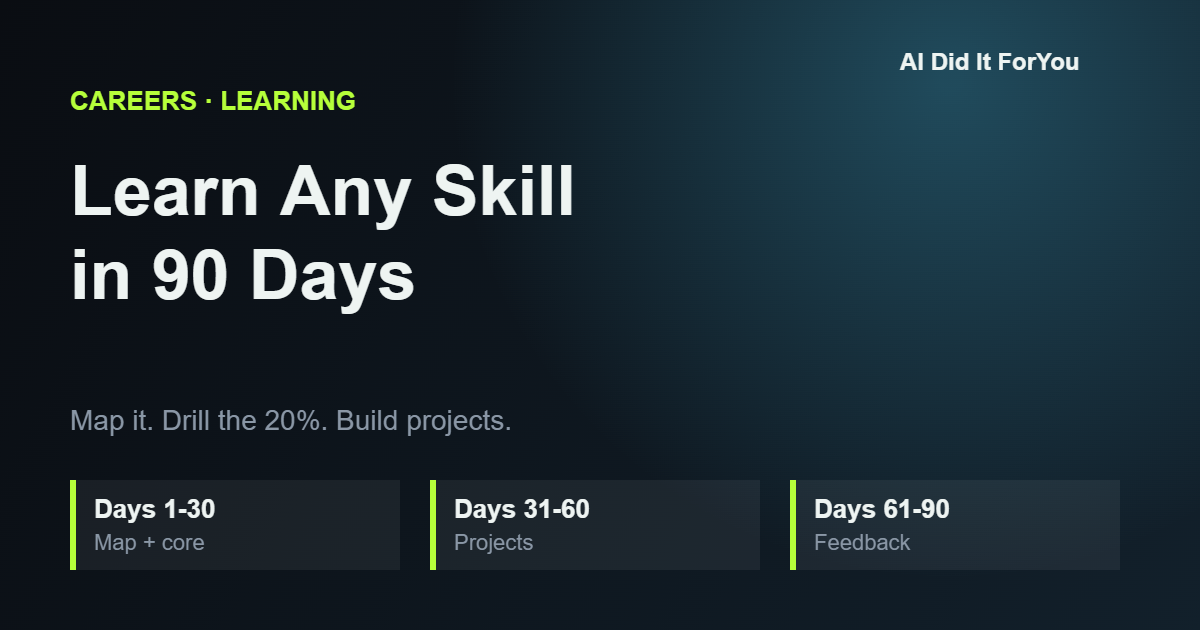
Think about the last skill you meant to learn. Maybe it was Excel, Spanish, video editing, or Python. You probably started with energy, watched a few tutorials, felt productive, and then stalled around week three. Nothing was wrong with you. Tutorials create the feeling of progress without the thing that actually produces it: practice that is hard in the right way, on the right material, with feedback.
This guide lays out a plan you can run in 90 days, explains why each part is there, and is honest about what 90 days can and can't buy you.
Why self-taught learning stalls
Three failure patterns show up again and again. First, no map: you don't know the sub-skills, so you learn whatever the next video covers rather than what the skill actually requires. Second, comfortable practice: you repeat what you already do fine, because it feels good. Third, no checkpoints: without a date and a visible output, "learning guitar" never becomes "I can play these three songs."
The research that sits behind a better approach is worth knowing, because it also tells you what to ignore. Psychologist K. Anders Ericsson and colleagues described deliberate practice in 1993: focused work on specific weaknesses, just beyond your current ability, with immediate feedback. A later meta-analysis by Macnamara and colleagues (2014) found that deliberate practice explains a real but limited share of performance differences, and a smaller share in some fields than others. So the honest takeaway is not "practice makes perfect." It's that how you practice matters, and that you shouldn't expect it to be the whole story. Separately, work on learning techniques (Dunlosky and colleagues, 2013, among others) rates practice testing and spaced practice as consistently effective, and rereading and highlighting as weak. Roediger and Karpicke's 2006 study showed that retrieving information from memory beat restudying it for long-term retention.
The 90-day structure
Days 1–7: Map the skill
Before practicing anything, break the skill into sub-skills and put them in order. For "learn SQL" that might be: selecting and filtering, joins, aggregation, subqueries, window functions, reading query plans. For "public speaking": structure, voice, pacing, handling nerves, Q&A. Spend a week skimming a couple of good syllabi, asking practitioners what a beginner gets wrong, and listing what doing the skill for real involves. The output is one page.
Days 8–30: Find the 20% and drill it
Pick the handful of sub-skills that unlock the most real use and spend your first month there. This is the 80/20 idea, and it's a heuristic rather than a law, but it works because skills have a heavy front end. In a language it's the few hundred most common words and the core sentence patterns. In design it's hierarchy, spacing and contrast. Each session should have one specific target, something you can't do cleanly yet, and a way to tell if you did it.
Days 31–60: Projects, not exercises
Now apply it. Build small, real things: a dashboard for your own spending, a two-minute talk to a friend, a landing page for an invented business. Projects expose gaps that exercises hide, because real work forces you to combine sub-skills and make decisions. Keep each one small enough to finish in a week or less. Finishing matters more than polish.
Days 61–90: Raise the difficulty and get feedback
Increase constraints: less time, no references, a real audience. Show your work to someone more experienced and ask what the weakest part is. Then fix that part. By day 90, you want three or more finished pieces you can show, and a short list of what you'd tackle next.
Two habits that make the whole thing work
- Test yourself early. Close the tutorial and try to do the thing from memory. It feels worse than rewatching, which is the point.
- Space it out. Revisit earlier material every few days. Short daily sessions beat one long weekend session for retention.
A worked example: learning Excel for a job change
Say you're an operations coordinator who wants to move into analysis and can practice 45 minutes a day. A reasonable map: formulas and references, lookups, pivot tables, cleaning messy data, charts, then basic automation. Your 20% is lookups, pivot tables and cleaning, because most analyst tasks live there. Month one: 20 short drills on exactly those, each with a messy sample sheet. Month two: three projects, such as a sales summary from a real export, a budget tracker, and a report you'd honestly send your manager. Month three: redo the first project in half the time, then have an analyst review one of them. You finish with proof of skill, which matters more on a resume than a course certificate. If you're turning that into a career move, pair it with our Resume Rewriter and LinkedIn Optimizer.
Let the free coach build the plan
Everything above is a template you can run with a notebook. But building the map and the schedule is the part people skip, so we made the Learn-Any-Skill Coach to do it. You enter the skill, your starting level (beginner, some basics, or intermediate), how much time you can practice and, optionally, why you want it. It returns a skill map in learning order, the 20% to prioritize, practice sessions, five project ideas and 30/60/90-day checkpoints. It's free and needs no login.
Where to go from here
Learning a skill is often the first step of a career move. A few related resources:
- If you're deciding what to learn, our Salary Replacement tool helps you weigh options against the income you need.
- Worried about automation? See AI-Proof Freelancer and our guide to building an AI-proof freelance career.
- Learning later in life? Read AI upskilling over 50.
- Applying with your new skill? Use the Ghost Job Filter so you don't waste time on postings that aren't real.
Frequently asked questions
Can you really learn a skill in 90 days?
You can reach a useful, demonstrable level in 90 days for most skills, meaning you can do real work at a beginner-to-intermediate standard. You will not reach mastery, which takes years. The realistic goal is competence you can show: a portfolio of small projects, not an expert title.
How much time per day do I need?
Consistency beats volume. Thirty to sixty focused minutes a day, five or six days a week, adds up to roughly 45 to 80 hours over 90 days. Short daily sessions also work better than one long weekend binge because spacing helps memory.
What is deliberate practice?
Deliberate practice, a concept from psychologist K. Anders Ericsson, means working on specific weaknesses at the edge of your current ability, with fast feedback, and then raising the difficulty. It differs from simply repeating what you already do well.
Is the 80/20 rule real for learning?
It is a useful heuristic, not a law. In most skills a small set of core sub-skills drives most early results (for example sentence patterns and common words in a language). Identifying them first lets you spend your earliest hours where they pay off most.
Is the free Learn-Any-Skill Coach a replacement for a teacher?
No. It builds a structured plan, practice sessions and checkpoints, but it cannot watch you perform. For skills where form matters, such as an instrument, a sport or surgery-level precision, add a human teacher or recorded self-review for feedback.
You need a system, not talent.
Name the skill, set your time budget, and get a 90-day plan in seconds.
Try the free Skill CoachAI transparency: This article was researched and drafted with AI assistance and reviewed for accuracy.
Corrections: Spot an error? Contact us or email [email protected].