AI & Careers · Policy Explainer
EU AI Hiring Rules: The Real Timeline (No, They Didn't “Arrive” in August)
A wave of career and HR blogs spent early August telling job seekers that the EU's “AI hiring rules” had just taken effect. That is not what happened. The August date is real, but the rule most of those posts described does not start until the end of 2027 — and the one part people are most worried about has actually been illegal since 2025. Here is the timeline that holds up against the primary sources.
Where the “August 2026” story went wrong
The confusion is understandable, because two real things happened within a week of each other. On 27 July 2026 a reform of the AI Act entered into force. On 2 August 2026 a scheduled batch of AI Act obligations became enforceable. Writers reasonably assumed the second date switched on the hiring rules. It did not. The 2 August milestone is about transparency and enforcement, not about the high-risk systems that screen job applicants.
Meanwhile, the reform that landed on 27 July did the opposite of what the headlines implied: instead of starting the high-risk hiring rules, it pushed them back. So the posts telling candidates that strict CV-screening safeguards were now live had the direction of travel backwards. The rules that matter most for hiring are further away than they were a month ago, not closer.
What actually went live on 2 August 2026
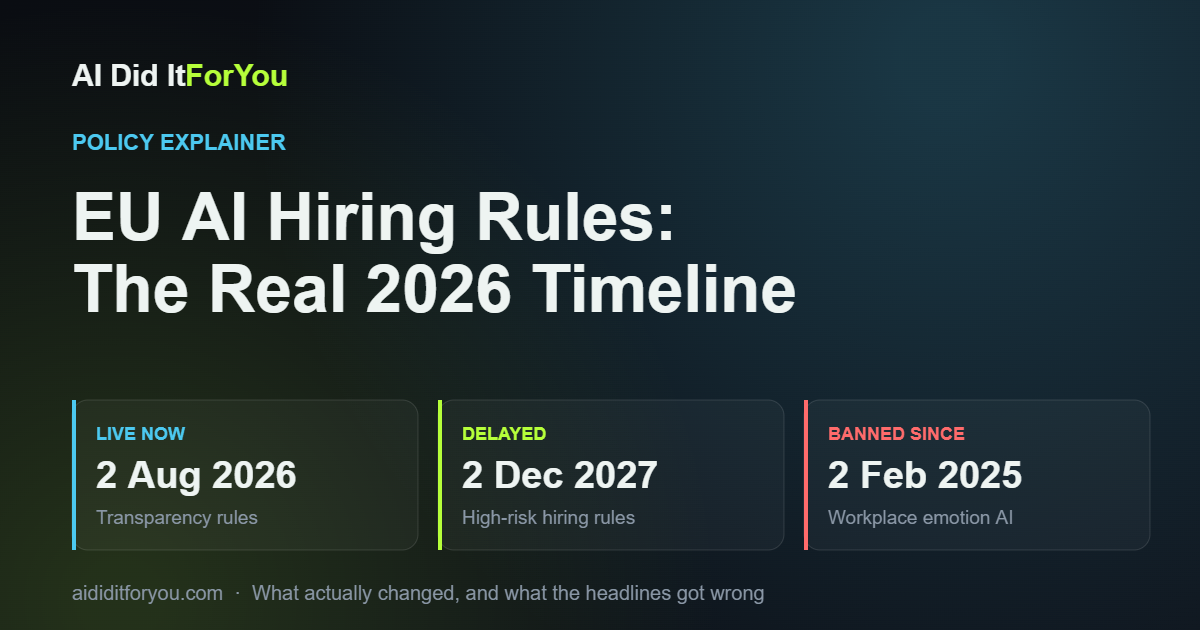
According to the European Commission's own announcement, 2 August 2026 is when it started enforcing AI Act rules and new transparency requirements. In practice that means a specific, limited set of duties under the Act's transparency article. People must be told when they are interacting with an AI system unless it is obvious. AI-generated or manipulated audio, images, and video — deepfakes — must be disclosed. And synthetic content has to be marked in a machine-readable format so platforms and tools can detect it downstream.
For a job seeker, the practical upshot is modest but real: if an employer runs an AI chatbot to conduct a first-round screen, that bot should now tell you it is AI. If a company circulates AI-generated video or imagery, it is supposed to be labelled. What did not switch on that day were the deeper protections around automated CV ranking — things like documented bias testing, human oversight, and your right to a meaningful explanation of an automated decision. Those belong to the high-risk tier, and that tier is on a different clock. If you want to understand the machine-readable labelling piece in more depth, we broke it down in our explainer on AI text watermarks.
What got pushed to 2 December 2027
The reform that changed the calendar is the Digital Omnibus on AI, which the Commission confirms in its notice that the AI Omnibus entered into force. Recruitment and worker-management systems sit in Annex III of the AI Act — the list of “high-risk” uses. Standalone high-risk systems in that annex were originally due to face their full obligations on 2 August 2026. The Omnibus moved that deadline to 2 December 2027, giving providers and employers more time to comply. For AI baked into products already covered by EU product-safety law, the relevant date moves later still.
This is the crux of the myth. The safeguards people actually care about for hiring — risk management, data-quality and bias controls, transparency about how the system works, logging, and human oversight of automated shortlisting — are exactly the obligations that were deferred. They are coming, and employers should be preparing now, but as a matter of enforceable EU law they do not bite until December 2027. Anyone telling you they are fully in effect today is describing a timeline that the Commission itself has already revised.
What has been illegal since February 2025
Here is the part the timeline debates keep missing. The AI Act does not only have a high-risk tier; it has a prohibited tier, and those bans came into force on 2 February 2025. Among them is a ban on using AI to infer a person's emotions in the workplace and in education, except for narrow medical or safety purposes. That prohibition is described in the Commission's regulatory framework for AI and enforced under Article 5 of the Act.
So the “mood-reading” interview tools that claim to score your enthusiasm, confidence, or honesty from your face or voice are not a future concern in the EU — deploying them on candidates is already unlawful today, and has been for over a year. This matters because worried applicants often assume the scary use case is the one still coming. In reality the most invasive use is the one that is already banned, while the more mundane CV-ranking rules are the ones still on their way.
Why this matters for you
If you are applying for jobs in the EU, or to EU-based employers, the honest picture is a mix of protections that are live, pending, and prohibited — not a single switch that flipped in August. Treat any blog that gives you one tidy date with suspicion, and check claims against the Commission's pages. Three things are worth holding onto:
- Emotion-inference in hiring is banned now. If an interview tool says it reads your feelings, that is not a grey area in the EU — it is prohibited.
- Disclosure is your right from August 2026. You should be told when a chatbot or screening agent is AI rather than a person.
- The detailed CV-screening safeguards start December 2027. Do not assume full bias-testing and explanation rights are enforceable before then.
There is also a question we get from candidates constantly: does any of this restrict me from using AI to prepare my own application? It does not. Using an AI tool to sharpen your own resume or letter is you using software — it is not the same as an employer deploying a hiring-decision system, which is what the high-risk rules govern. So it remains perfectly fine to run your CV through our Resume Rewriter, draft a tailored note with the Cover Letter tool, tighten your profile with the LinkedIn Optimizer, or screen out fake postings with the Ghost Job Filter. The rules are aimed at the systems that decide, not the tools that help you apply.
One caveat worth keeping in mind: transparency rules do touch AI-generated content. If you were ever to submit AI-generated video or imagery as part of an application, labelling expectations can apply. Writing assistance for text does not put you in that bucket, but it is a line worth understanding rather than guessing at.
Go deeper
Turn the rules into an advantage
If you want a structured, human-reviewed plan for a modern, AI-aware job search — not just tools, but a system — our paid program walks you through it end to end.
Explore the Career AcceleratorFrequently asked questions
Did the EU's AI hiring rules start in August 2026?
No. 2 August 2026 was the AI Act's transparency and enforcement milestone. The detailed rules for high-risk recruitment systems, such as CV screening and candidate ranking, were postponed to 2 December 2027 by the Digital (AI) Omnibus reform.
When do the EU's high-risk rules for recruitment AI actually apply?
2 December 2027 for standalone Annex III high-risk systems, which include recruitment and worker management. The date was deferred from 2 August 2026 by the AI Omnibus, which entered into force on 27 July 2026.
Is AI that reads your emotions in a job interview legal in the EU?
No. Emotion-recognition AI in the workplace and in education has been prohibited under Article 5 of the EU AI Act since 2 February 2025, except where used for medical or safety reasons.
What actually changed on 2 August 2026?
Transparency obligations began to be enforced: AI chatbots must disclose that they are AI, and AI-generated or manipulated content such as deepfakes must be labelled and marked in a machine-readable format, alongside general-purpose AI model duties.
Can I still use AI to write my resume or cover letter?
Yes. Using an AI tool to draft your own job application is not a high-risk activity under the AI Act. The high-risk category applies to systems that make or materially assist an employer's hiring decisions.